“You can check out any time you like, but you can never leave.”
The Eagles may have been talking about the lovely Hotel California in their song, but these famous lyrics ring true, for none other than the inescapable digital world. The Internet is not a place we visit; it is a place where we now live. Social media promised us connection, by becoming a way for us to be closer than ever before. But in reality, social media feels less like a community and more like a system of surveillance—one where we are always watched, always performing, and never truly offline.
No one knows this better than a celebrity. In an attention economy, where holding someone's gaze is currency, fame is the ultimate wealth. But in this instance, to be famous is to be trapped. Celebrities exist in a glass prison, where every word, every action, every expression is dissected by an audience that never looks away. Their eyes are omnipresent, and one can almost hear the echoes of George Orwell's 1984:
“Big Brother is watching you.”
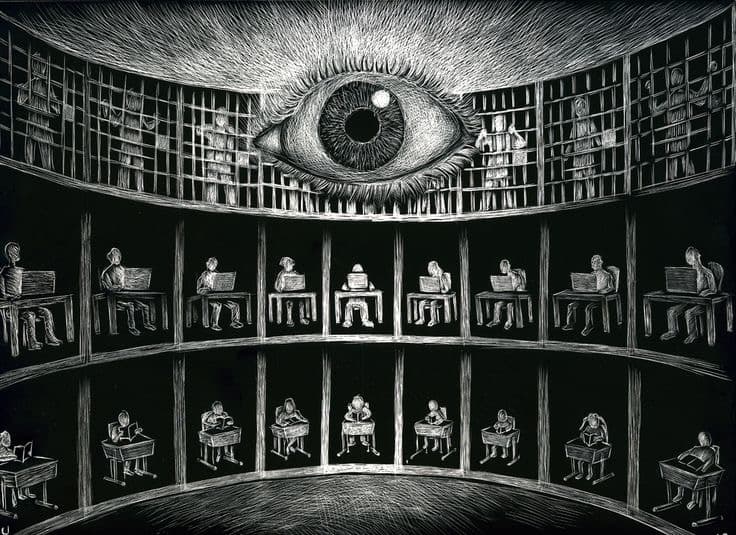
Orwell's vision of state surveillance may have been fiction, but it speaks a larger truth about control through observation. English philosopher Jeremy Bentham gave this concept a tangible form with the Panopticon, a real-world model of power where surveillance is constant yet invisible. The panopticon is a design of institutional building with an inbuilt system of control, built in a circular shape, with a single watchtower standing in the center. Prison cells surround this tower, allowing the guard inside to see every inmate, at all times. However, the prisoners are unable to see the guard and therefore, they are left in a state of uncertainty—an uncertainty that compels them to behave as if they are always being watched. This is precisely how social media operates today, where users exist under the illusion of freedom while being constantly monitored.
Celebrities are the ultimate prisoners of this system. Their existence is defined by constant surveillance, not just from institutions but from the very people who elevated them to fame. Every moment, they are expected to maintain their carefully crafted personas, aware that a single misstep could ruin everything. This is why Public Relations agents exist—to curate inauthentic authenticity, to ensure that every word, every image, every candid moment is anything but accidental.
But what happens when this illusion cracks? What happens, when the celebrity can no longer maintain the facade of their manufactured persona? When the prison glass shatters, the panopticon transforms into the Colosseum. The prisoners are thrown into the arena, and the public becomes their executioner.
The same audience that once admired them, now turns against them, ready to judge, shame and condemn. This shift is at the core of cancel culture—the contemporary Colosseum. A single controversy can turn admiration into hostility, and once the audience decides that someone has failed them, the punishment is swift. This phenomenon isn't new—Foucault described public executions as a spectacle designed not just to punish, but to reaffirm the power of the watchers. In the digital age, the same logic applies, where a celebrity's downfall is broadcast, dissected, and consumed as entertainment.
But unlike traditional prisons, there is no escape, no sentence to serve before release. Even in exile, the shadow of surveillance lingers, forcing them to maintain the facade long after the spotlight has dimmed. The fear of judgment persists, forcing individuals to conform to expectations even when no one is visibly watching. Some celebrities attempt comebacks, carefully rebranding themselves to win public favor again. Whereas others disappear, as ghosts trapped in the corpses of their former fame, unable to exist beyond the image they once curated. In the worst cases, they become symbols of tragedy—icons of a system that both created and destroyed them.
Sadly, this system is no longer exclusive to celebrities, as social media has made everyone a performer. The everyday citizen is also a subject of scrutiny, and has to turn their everyday life into a performance. We curate our own personas, choose our best angles and always share only the most appealing parts of our lives. The pressure to be perceived a certain way is not imposed solely by external forces—it is internalised. As Foucault argued, true control is not about physical confinement, but about conditioning people to regulate themselves. Everyone is both the watcher and the watched, trapped in a cycle of self-discipline.
Foucault once wrote, “Visibility is a trap.” The digital panopticon ensures that no one, especially those in the public eye, can escape scrutiny, since there are constant eyes on them. Their carefully curated personas may shield them for a while, but when the illusion shatters, the same audience that once adored them, becomes the mob that tears them down. In this age of relentless surveillance, stepping away is not an option.
Because in the end, you can check out any time you like, but you can never leave.
