
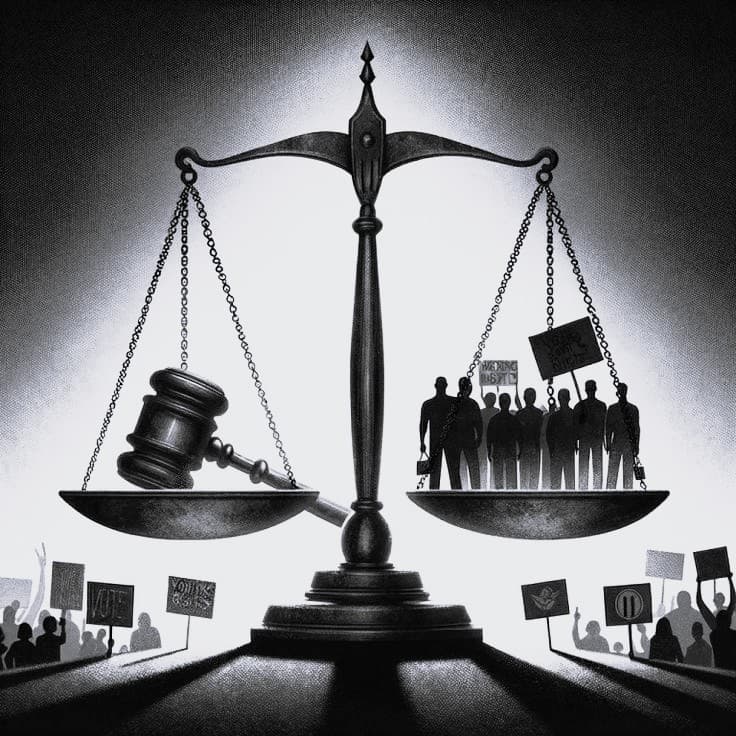
Prelude: The Digital Guillotine
The court of public opinion has no gavel, no robes, no due process—only headlines, hashtags, hysteria
In today's hyper-connected India, where every smartphone doubles as a news channel, where every tweet has the power to make (or break) a reputation; justice is no longer confined to the sterile halls of a courtroom. Instead, it unfolds on screens, in social media's fevered chatter, through headlines that outrun due process— trial by tweet, judgment by trending.
This is the story of our times—a tale of trials by the media where the press becomes judge, jury, and executioner, leaving behind a trail of collateral damage that the legal system struggles to mend.
The Indian Media Frenzy
What happens when news moves beyond reporting facts and begins shaping public perception of guilt or innocence? With 24/7 news and social media's explosive growth, cases that once crept through quiet court corridors now dominate digital billboards and WhatsApp groups, often before a single piece of concrete evidence is presented in court.
A scandal breaks—a high-profile crime, a shocking murder, an alleged corruption case. Within hours, the accused's name dominates headlines and social media feeds. Viral posts, YouTube rants, and heated television debates create a storyline where speculation outweighs facts. As media outlets compete for engagement, the principle of 'innocent until proven guilty' becomes a casualty of public outrage.
In the modern Indian context, the media frenzy is not just about reporting events; it is about framing narratives that often steer the course of legal proceedings. Indian journalism has long been hailed as a pillar of democracy, a watchdog holding power to account. Yet in the modern era, the chase for higher TRPs and viral content has sometimes transformed these watchdogs into hounds—sniffing out scandal and pursuing sensationalism at all costs. This sensationalism sets the stage for notorious cases that reveal the darker side of media trials.
Case Study I: Jessica Lal
One of India's most high-profile cases of trial by media is the Jessica Lal murder case (1999). Jessica, a young model and socialite, was fatally shot at a high-profile party in Delhi, and the primary accused, Manu Sharma, was the son of a powerful politician. The case initially saw several eyewitnesses turning hostile, leading to Sharma's acquittal in 2006. However, intense media scrutiny and public outrage led to widespread protests, ultimately resulting in a retrial. Sharma was later convicted and sentenced to life imprisonment.
Sensational media coverage, though controversial, sometimes pressures authorities to act. Public pressure eventually forced a retrial, leading to Sharma's conviction. Yet, due process paid the real price. The headline-driven narrative had already etched a verdict in the public mind—one that was impossible to unwrite.
Justice is not a commodity to be traded in likes and shares—it is a process, slow and deliberate, that demands our collective vigilance.
The Jessica Lal case remains a cautionary tale: while media intervention can sometimes prompt justice, it often does so at the expense of nuance and fairness.
Case Study II: Aarushi Talwar
Fast forward to 2008, when the serene façade of a quiet town was shattered by the mysterious murder of of 13-year-old Aarushi Talwar, whose body was found in her home. The situation became even more complex when the family's domestic worker, Hemraj Banjade, was also discovered murdered. What followed was a sensational media frenzy that often prioritized speculation over verified facts. Theories ranged from honor killing to conspiracy, with media trials often shaping public opinion before the courts had a chance to fully examine the evidence.
Journalists and commentators, driven by the race for the next big scoop, began constructing narratives laden with speculation and emotion. With scant evidence to anchor their stories, the media environment became a pressure cooker of theories and accusations, each vying for public attention. The case rapidly morphed from a legal investigation into a sensational media circus, where every twist was amplified and every unverified detail served as fodder for debate. This case did not just tarnish reputations—it undermined the very essence of the judicial process, showing how media hype can distort public understanding and derail the path to genuine justice.
Both Jessica Lal's and Aarushi Talwar's cases underscore a critical reality: when media outlets assume the role of judge, jury, and executioner, they risk compromising the integrity of justice.
Media, Data, and the Illusion of Accountability
Justice is blind, but the media sees what it wants to—and ensures the world does too.
Sensationalism drives viewership, and nothing fuels the news machine quite like scandal. In their relentless pursuit of eyeballs and engagement, news outlets often prioritize the most dramatic, emotionally charged aspects of a case over the nuanced, often tedious legal realities. When narratives are selectively framed, they shape public perception in irreversible ways. A well-placed headline can turn an innocent person into a monster, a guilty person into a victim. And when people consume news in bite-sized, context-stripped snippets, the appetite for nuance disappears entirely.
This new digital paradigm has blurred the lines between journalism and adjudication. With the speed of a retweet, unverified claims can snowball into full-blown accusations that are almost impossible to counteract once they take hold. The digital age has thus given rise to a modern guillotine—a system where swift, often unchallenged public opinion can decimate reputations even before the legal process has had its chance to deliver justice.
When outrage dictates narratives, truth becomes secondary to virality.
The Collateral Damage: Families, careers, and more
Trial by media doesn't just punish the accused—it wrecks lives in its wake. Families are dragged into the chaos, workplaces are pressured into swift dismissals, and social circles fracture under the weight of public shaming. Even when someone is acquitted, the stain of accusation never truly washes off.
But perhaps the greatest casualty of trial by media is the justice system itself. When public pressure dictates legal outcomes, due process becomes an afterthought. Prosecutors feel compelled to press harsher charges, judges fear leniency, and juries—now privy to round-the-clock coverage—struggle to remain impartial. The rule of law bends under the weight of collective outrage. The collateral damage is a sobering reminder that when the media supplants judicial processes, everyone pays the price.
Epilogue: Justice in the Age of Hashtags
In today's world, where a tweet spreads faster than a court summons and a viral post can decide someone's fate before a judge does, we have to ask ourselves—are we after justice, or just a juicy headline?
Trial by media isn't just about news; it's about power.
The power to ruin lives, to shape narratives, and sometimes, to force the right questions to be asked. But when outrage replaces evidence and clicks count more than the truth, we all lose. Justice isn't about being the first to react—it's about getting it right. So before we hit the share button, maybe we should pause and ask whether there's more to the story than show. In the end, justice isn't the court's responsibility, it's ours too.
True justice is not found in hashtags or headlines, but in the slow, deliberate work of the courts.
